
Minnesota Resident Lookup Records at a Glance
Check one record source at a time: property rolls identify owners or taxpayers, court files name parties, and vital indexes point to events. Each public result answers a narrow question.
| Record | What It Confirms | Where to Search | Access |
|---|---|---|---|
| Property and tax | Owner or taxpayer, parcel, property address, and sometimes a mailing address | County assessor or GIS office | Public parcel data; occupant is not implied |
| Voter status | A registration match at an address and a status message | MNVotes; county or state election office | Name, date of birth, and address; list access has limits |
| Court case | Party, county, case type, dates, register, and eligible documents | MCRO; MNPAC and court administration | Remote access is narrower than courthouse access |
| Birth or death index | Event date, county, and sometimes certificate number | Historical index; MDH | An index is not a certified record |
| Birth or death copy | Official event information in an eligible product | MDH Office of Vital Records or county office | Certification has eligibility and identity rules |
| Marriage or divorce | Marriage event or a court decree | MOMS and issuing county; district court | Marriage and divorce have different custodians |
| Business or license | Entity filing, public address, credential status, or order | SOS Business Services; eLicense or board | Affiliation is not proof of residence |
| DOC status | Adult DOC status or legally disclosed registrant details | Minnesota DOC public search tools | Limited to the record types the law makes public |
Use the county for court or property searches, event and county for vital records, or the person's name, birth date, and address for voter status. A parcel record names an owner or taxpayer, not every occupant.
Search MCRO to Verify a Minnesota Resident
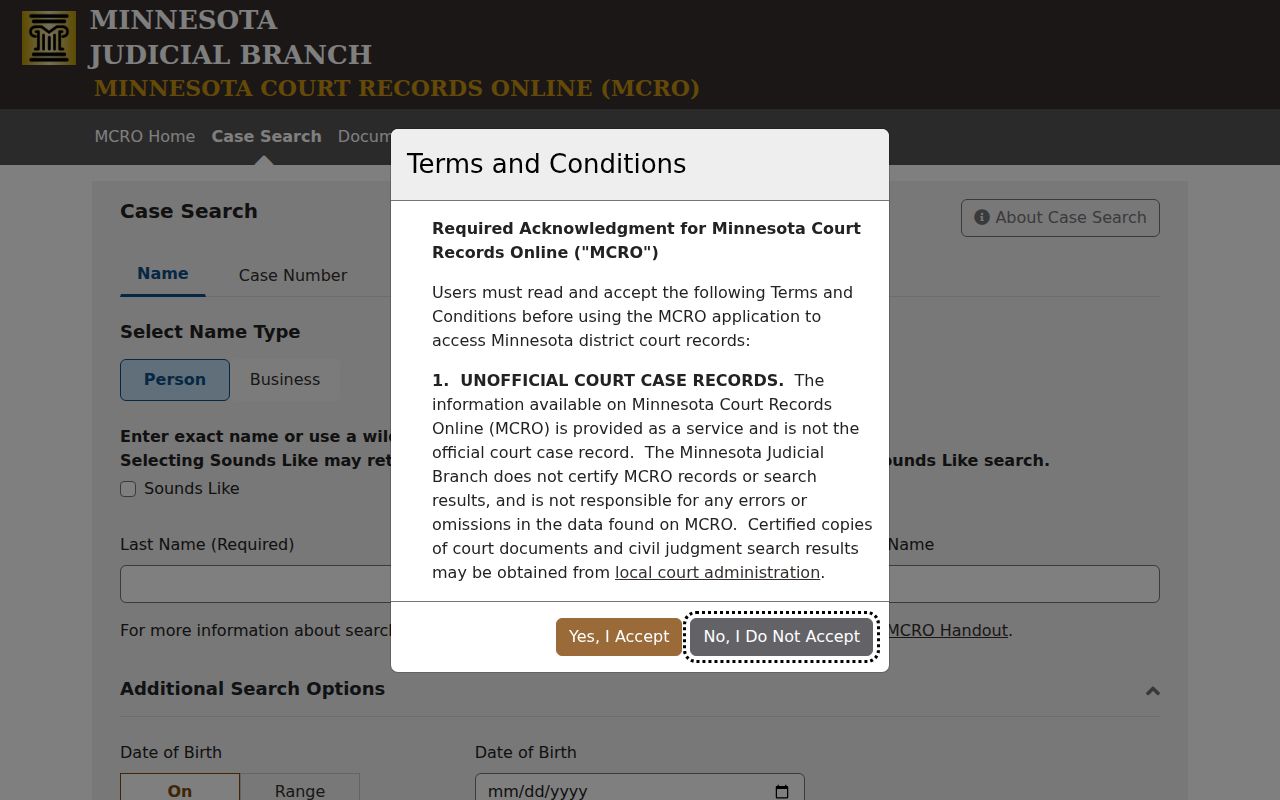
Minnesota Court Records Online searches district-court cases statewide through Case, Document, Hearing, and Judgment Search. A name search takes a person or business, exact text or a trailing asterisk after two characters, and optional Sounds Like, which cannot pair with a wildcard.
| Field label | Type | Required | Options or format notes |
|---|---|---|---|
| Name type | Radio/button | Yes for name route | Person or Business; exact or trailing * after two characters; Sounds Like cannot combine with wildcard |
| Last Name | Text | Route-dependent | Exact-name logic; try variants and middle-name/no-middle-name searches |
| First Name | Text | Optional | Name search; exact or wildcard behavior |
| Middle Name | Text | Optional | Middle name or initial; leave blank to test more variants |
| Date of Birth | Date/radio | Optional | Exact date or date range; MM/DD/YYYY |
| Date Filed | Date/radio | Optional | Exact date or date range; MM/DD/YYYY |
| Case Category | Checkbox | Optional | Civil; Criminal; Family; Probate or Mental Health |
| Case Status | Select | Optional | Status choices appear in the application; use all unless known |
| Court Locations | Radio/checkbox | Optional | Statewide or select specific county court locations |
| County search | Text/filter | Optional | County field plus alphabetical selectors for all 87 counties |
| Case number | Search-tab text | Route-dependent | Exact case identifier |
| Citation number | Search-tab text | Route-dependent | Citation search route |
| Attorney | Search-tab text | Route-dependent | Attorney name or bar number |
The MCRO form shows the name, date, category, and county controls.
Check identity across records; a similar name is not enough.
Minnesota Resident Case Results Have Limits
MCRO is an unofficial remote copy. From July 1, 2015, it includes all documents in major and minor criminal and civil cases, and formal or other probate, guardianship, conservatorship, and trust cases. Selected court-prepared orders, opinions, and notices appear in family and post-adjudication paternity matters. Older judgment, order, opinion, and notice coverage runs July 2005 through June 2015; earlier access is limited.
Check party role, county, filing date, and Register of Actions before reading a category label as an outcome. A docket is the dated list of filings and court actions.
- Case identity: case number, category, county or court location, filing date, and status.
- Party detail: name, role, attorney, public-data marker, and active-warrant flag where shown.
- Events and hearings: Register of Actions dates, descriptions, document-index numbers, and hearing information.
- Judgment: debtor name, docketed date, status, and satisfaction detail where displayed.
- Documents and limits: title, page count or “Unknown,” available downloads, and records withheld from remote view.
| Access point | Coverage difference |
|---|---|
| Remote MCRO | Public case information in its date and case-type scope; street addresses and comments are omitted. |
| MNPAC courthouse terminal | May add abuse/harassment, CHIPS, D16, civil-commitment, address/comment, and pending defendant-name cases; some pending searches need a case number. |
| Other courts | Federal matters use PACER; municipal records may sit with a local court or city office. |
Verify One Minnesota Resident Across Records
Test one identity at a time and record its county, date, and source. If you start with an address, the Minnesota street-address path can separate a parcel owner from a person you are verifying.
- Note the full name, likely Minnesota county, age range, and any known address.
- Search MCRO with name variants, middle initial, no middle name, and Sounds Like.
- Compare county, date, and case role with property, business, voter, or obituary records.
- Use a vital index for the event and certificate number, then ask the custodian for a copy.
- When dates or roles conflict, contact the office that made the record.
- Docket
- A dated list of court filings, hearings, and actions.
- Index vs. image
- An index points to a record; an image is a scan or copy of its source page.
- Certified copy
- A copy authenticated by its custodian; a free online image is not certified.
Minnesota Resident Status at MNVotes
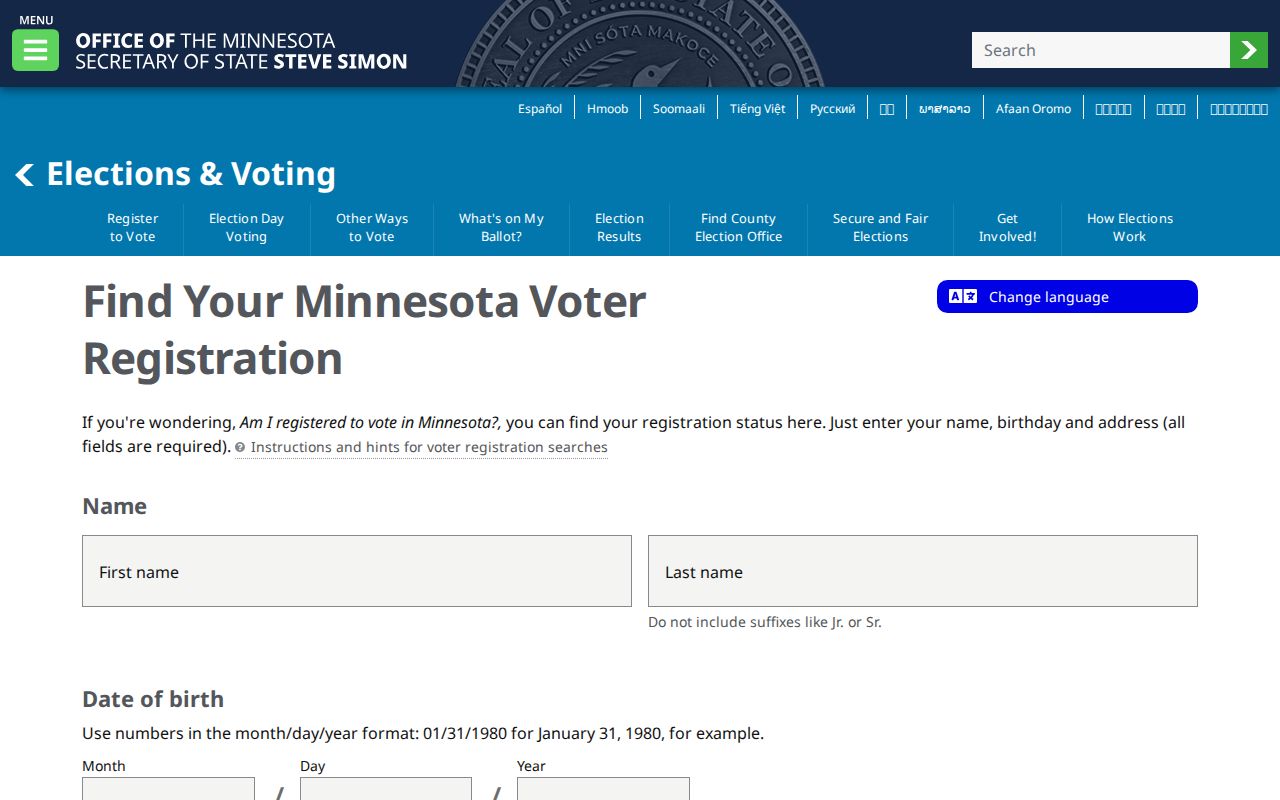
MNVotes checks a person's own status, not a browseable directory. It requires first and last name, date of birth, and address. Choose ZIP Code or County mode; names take A–Z, spaces, hyphens, and apostrophes, but no accent marks or Jr./Sr. suffixes.
The Minnesota Secretary of State lookup updates nightly, but an election office can take up to 14 days to process an application. A match provides a confirmation and voting-information links; a mismatch gives a status or next step. Protected voters may not have a real address exposed.
Under Minn. Stat. §201.091, the public list may show name, address, birth year, voting history, optional phone, and districts. It omits full birth date, SSN, license/ID, military ID, passport number, and presidential-primary party choice. Only registered Minnesota voters may order a list for a permitted election, political, or law-enforcement purpose; a walking list is sorted by street.
List orders go by mail or in person, not online. The form lists $46 statewide or $30 locally, with five-business-day processing; large areas use text files. See the Secretary of State voter-list rules.
Minnesota Resident Lookup Through Vital Records
MDH and county offices keep birth/death records. MOMS indexes most Minnesota marriages; the issuing county holds a certificate, and district court administration holds divorce decrees. Historic indexes cover births from 1900–1934 and deaths from 1904–2001; a death hit may give date, county, certificate number, and in many years birth details or a mother's maiden name.
Anyone may obtain noncertified death information; certified death copies require eligibility and attestation. Certified birth copies require an eligible relationship, ID, and a signed or notarized form. Birth data for an unmarried mother's child are generally confidential unless she designates them public; adopted-person original records follow separate rules.
County offices often serve people fastest. Noncertified births are available through any Minnesota county, except events in 2000 or earlier must go through the birth county or MDH. MDH accepts mail or fax, not walk-ins or emailed applications. For deaths, pre-1908 records come from the county of death, 1908–1997 from that county or MDH, and 1997 onward from any county. Marriage fees vary by issuing county.
Use the MDH Vital Records page or the county registrar directory for forms. Noncertified birth requests ask for the subject, event, parents, requester, product choice, payment, and signature; some offer a printout or record-copy option. An index or informational copy is not a certified record.
Official Minnesota Routes for Heirs and Birth Parents
Probate files can name a decedent, personal representative, heirs, addresses, assets, will, inventory, and distribution. This can support an heir search, but an estate address does not prove a current home.
Birth-parent research must use Minnesota adoption and original-birth-record procedures, including the Minnesota Fathers' Adoption Registry where relevant. A former classmate may appear in yearbooks, alumni archives, newspaper indexes, or the Minnesota historical directory collections. Ask MDH or the court about access to sealed or confidential files.
Minnesota Resident Checks Through Business Records
The Secretary of State Business Filings search finds an entity by name or file number. Name controls include Begins With/Contains, active or inactive status, and prior names; details show filings, renewals, registered office, and agent. This corroborates a public business role, not residence.
An assumed-name filing links a person or entity to a trade name and address. It must be renewed yearly and published in two consecutive issues of a local legal newspaper. Copies need an account: $3 per filing plus a $10 online fee, with $5 more for certification; older copies can take three to seven business days.
Minnesota eLicense routes to board-specific credential searches, and fields or update timing vary by board. Treat a license result as a dated credential record, not a current-address source.
Minnesota DOC Records Have a Narrow Public Scope
The DOC public viewer covers adults under DOC jurisdiction, not every Minnesotan or county jail. A detail may show DOC ID, name/AKA, birth date, status, facility, sentence and release dates, case number, offense, and caseworker contact. Records post within 48 hours after law-enforcement authorization.
Open the official Minnesota DOC Public Viewer to inspect adult custody details.
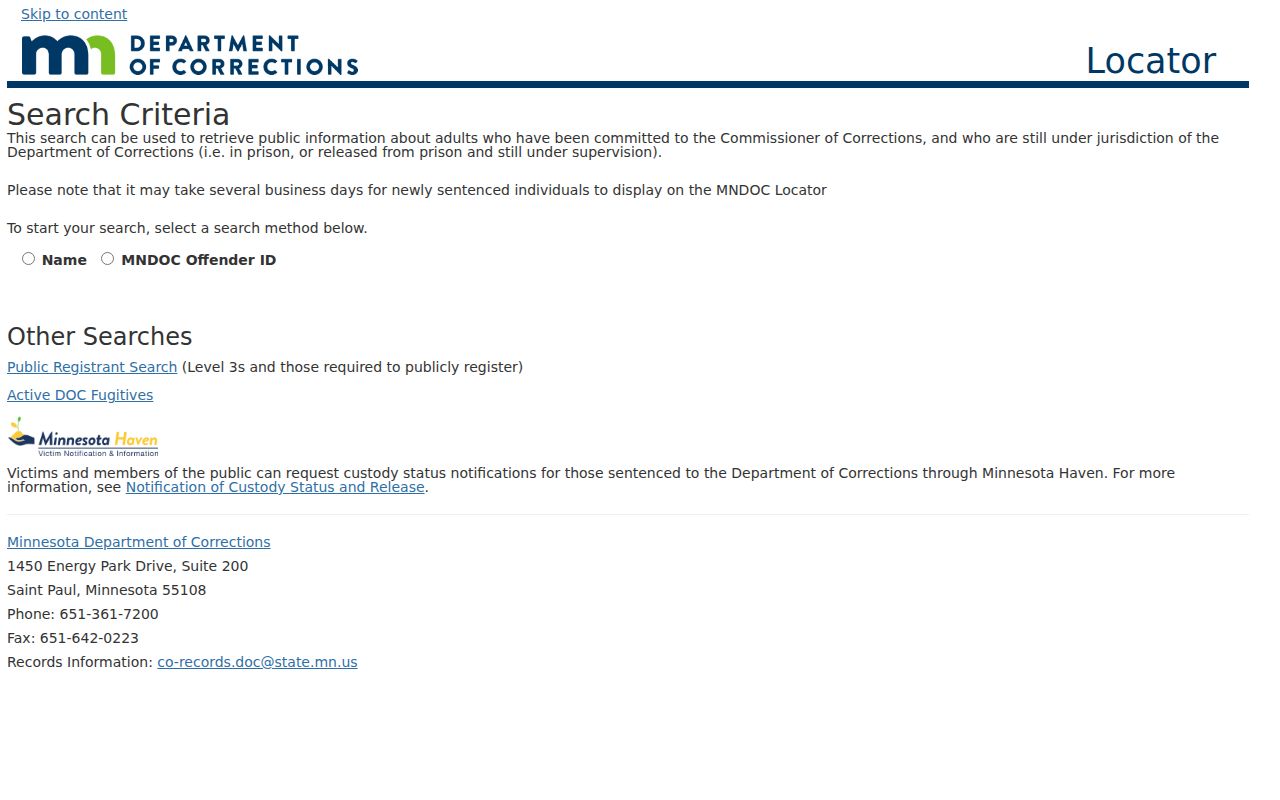
The viewer shows DOC custody status and dates, not a county-jail roster.
The separate Public Registrant Search shows only information an authorized agency discloses under law. What appears depends on the disclosure rule and current status.
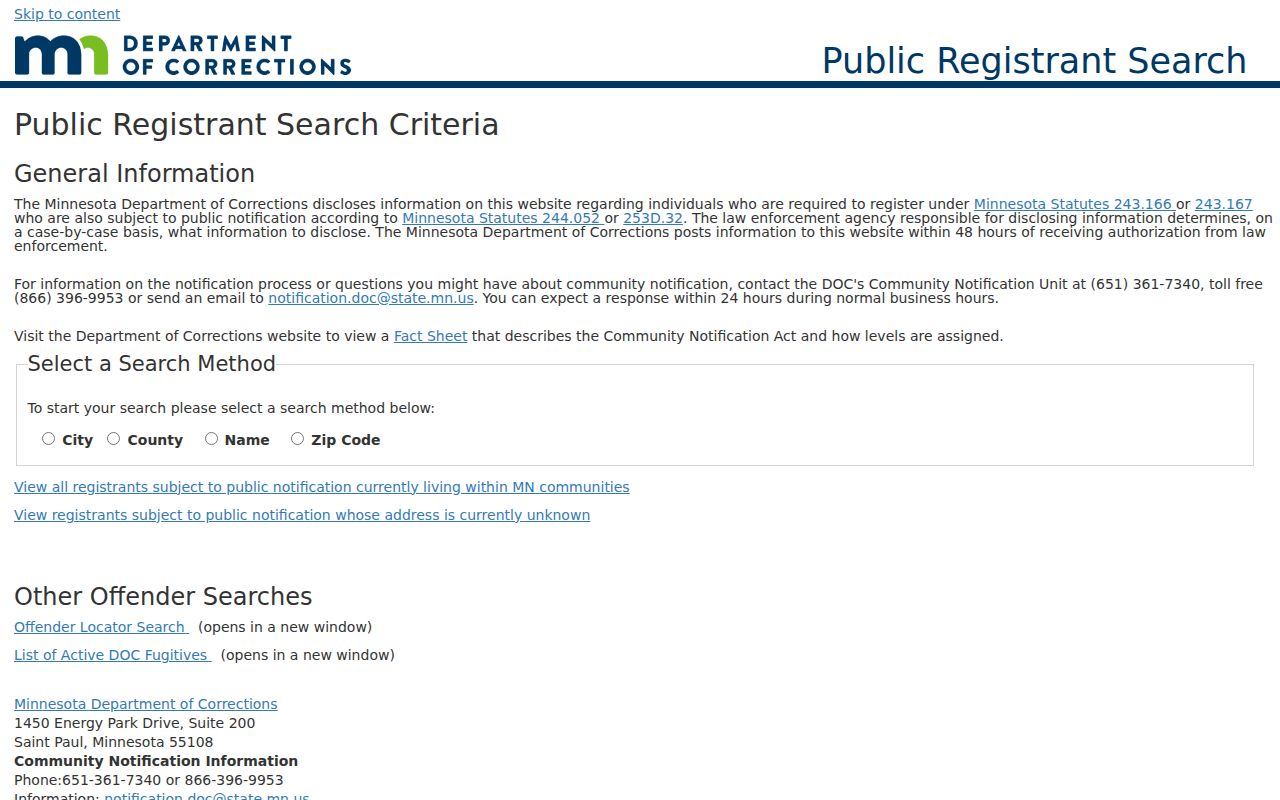
Neither tool is a statewide resident roll. For local custody or a missing detail, use the county sheriff or corrections office that holds the record.
Privacy Limits on a Minnesota Resident Lookup
Minnesota's Government Data Practices Act opens public data unless a law classifies it otherwise. Court, voter, adoption, and Safe at Home records each hide different details; motor-vehicle addresses are also restricted. Ask the custodian what can be released before treating a missing field as an error.
Safe at Home supplies an enrolled participant a substitute PO Box and forwards first-class mail. Program details are private; a real address is disclosed only under a valid court order or formal emergency/criminal-investigation process. Call 651-201-1399 in the metro or 1-866-723-3035 elsewhere, weekdays 8 a.m.–3:30 p.m., or contact the Secretary of State Safe at Home office.
Lawful personal use. Use Minnesota records for lawful research. Repeated monitoring, threats, or misuse of a person's information can violate Minn. Stat. §§609.748–609.749; public access does not permit stalking or harassment.
If an online case search misses a file, use any courthouse's statewide terminal, the counter for paper records, or ask court administration to search archived/off-site files. Uncertified copies are free; certified copies generally cost $14, and certified plus exemplified copies $28. Mail requests use a form or letter; nonparties may eFile/eServe with a clerk-issued administrative case number. Sealed records need a court access form; birth-parent identifying information has a separate route.
For other public data, request the office, record, dates, fields, and format under Minn. Stat. chapter 13. Inspection is free; copies may cost money, and a denial must cite law. Agencies need not create a missing record. Send corrections to the court, MDH/county, assessor/recorder, or election office that made it.