
Minnesota Previous Residents: Address Record Eras
People who lived at a Minnesota property appear in sources with different date ranges and definitions. A deed shows parties to a transfer, a directory lists people by year and address, and a census records a household on its census date. The table keeps those roles separate. Start with the source closest to the year you need, then add a second source that can confirm the same parcel or household.
| Source | Years It Covers | Where Held | What It Shows |
|---|---|---|---|
| County deed and title | County-specific; Hennepin's recent online list covers five years and may be incomplete | County recorder / registrar | Parties, instruments, liens, legal description, abstract or Torrens title |
| Minnesota eCRV | Accepted/completed electronic records, October 2014–present | Minnesota Revenue and county | Sale certificate and terms, not a deed or title chain |
| St. Paul directories | Digital 1856–1922; fiche 1856–1859; film 1863–1935; print 1938–present | St. Paul Public Library | Names, streets, house numbers, household adults, owner and phone symbols |
| Minneapolis and Hennepin directories | Minneapolis 1859–1950; Edina 1941–1977; Hopkins 1942–1977; St. Louis Park 1933–1977 | Hennepin County Library | Searchable name and address images for listed years |
| Hennepin suburban area | 1956–1988, plus city-specific runs | Hennepin County Library and print collections | Reverse address context, with local coverage gaps |
| Federal census | Released through 1950 under the 72-year rule | National Archives and census collections | Household members, ages, birthplaces, relationships, occupations |
| Minnesota state census | Index spans 1849–1905; schedules in 1857, 1865, 1875, 1885, 1895, 1905 | Minnesota Historical Society | Age, gender, ethnicity, birthplace, location, parents' birthplaces |
| St. Paul permits | Public search 2000–current; permits from 2000; Public Works 2006–current | City of Saint Paul | Permit, inspection, code, and address activity |
| Minneapolis lot surveys | Selected permit work from 1916–1965; not every building | Hennepin Library, city, and University of Minnesota collections | Footprints, dimensions, outbuildings, permit links |
| Sanborn maps | Minnesota city lists for 1867–1950 and 1950–1970 | Minnesota Historical Society, Library of Congress, libraries | Building footprint, use, materials, and block geography |
| Newspapers and obituaries | MNHS collection 1849–today; Pioneer Press digital 1861–1961 | Minnesota Historical Society and St. Paul Public Library | Death, sale, move, civic, and household references |
For a recent transfer, begin with the assessor and recorder, then use eCRV only to check the sale certificate. For an older household, start in the library's address section and pair each result with a census or directory year. Building maps and permit files can explain a change to the parcel; they do not name every person who lived there. The statewide Minnesota record path often ends at a county counter, library, archive, or copy request rather than in one online search.
Note: These dates describe the collections listed here; confirm a city's surviving run before treating a missing year as a gap in the household's history.
Minnesota Deed Records: Five-Year Window
Hennepin County makes one limit easy to miss: its recent recording history is online for only the latest five years, and the county says that list may be incomplete. Older Minnesota deed work needs a wider search. The county land-record access page points to limited free RecordEASE indexes, paid online document views, weekday research kiosks at the Skyway level of 300 South Sixth Street, room SK-0353, and the county counter. Kiosks are open from 8 a.m. to 4:30 p.m. on weekdays.
For a deed or certificate, phone or email the office at 612-348-5139 or recordsrequest@hennepin.us. Mail orders must include the document or certificate number and type. Owners can ask by email for a free electronic deed or certificate copy. RecordEASE Pro viewing is $2.50 per document, certificate, or plat. Mailed noncertified documents cost $1 per page; certified documents or certificates are $10; plats are $10 noncertified or $15 certified. Online certified orders require an account and add a $3 service fee to the $10 document/certificate or $15 plat charge. Mail orders are processed in one to two business days.
That five-year limit describes Hennepin's recent online recording-history list; it is not a statewide Minnesota cutoff. Each recorder or registrar controls its own image coverage, historical index, research terminal, and copy request. For another county, start with its recorder page and ask whether older grantor-grantee books, plats, or title records are at a counter or archive. A missing image can mean the online collection stops there, not that the instrument was never recorded.
Research tip. When a Minnesota address search reaches the five-year screen, change the key to a legal description or party name and continue at a kiosk, counter, or copy desk.
Minnesota Previous Residents and eCRV Sales
Minnesota's eCRV is a sale-data bridge, not a title record. A real-property transfer for consideration over $3,000 requires a certificate, and the public search contains accepted or completed electronic certificates from October 2014 onward. The search offers Custom Search, eCRV ID, and Parcel ID modes; the parcel form uses Preliminary or Completed status, County, and Parcel ID.
Open the current Minnesota eCRV public search before following a sale from a parcel. The screen below shows the public search interface for a certificate trail.
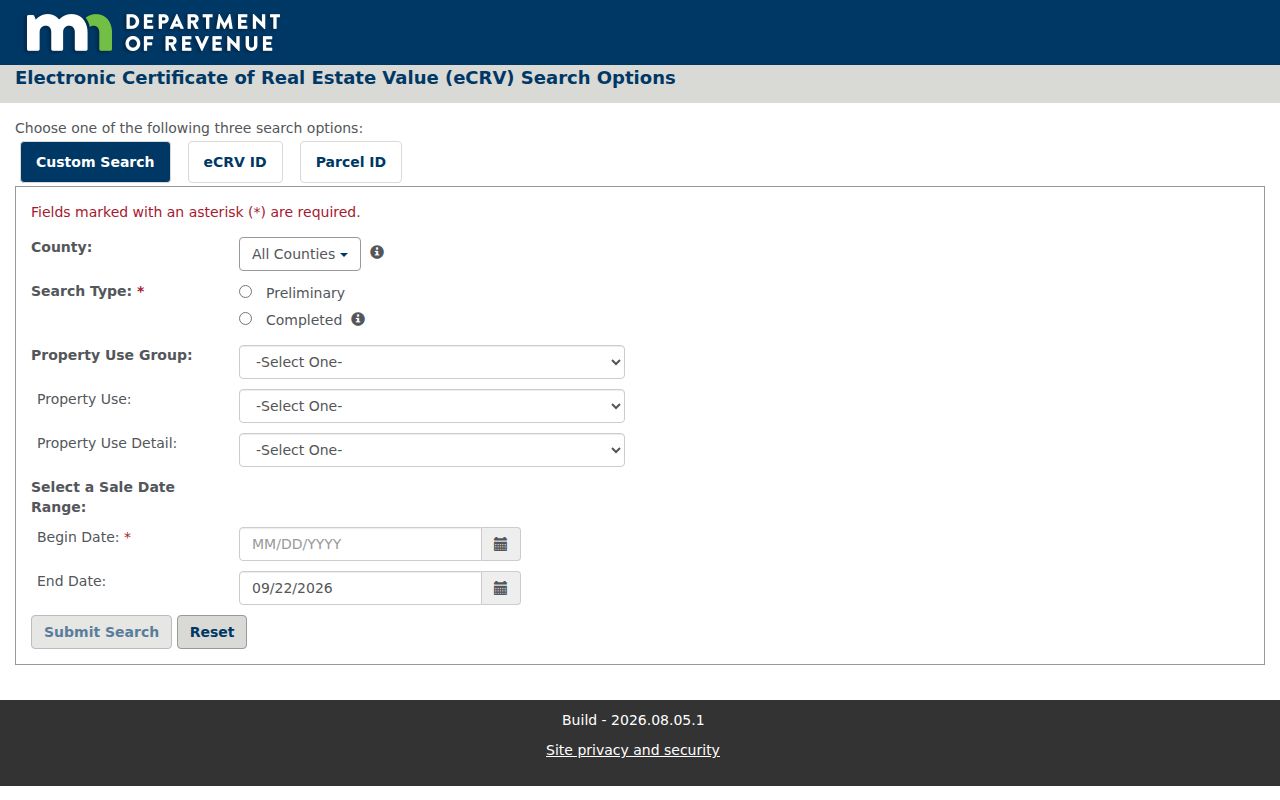
An eCRV can supply sale terms and parcel identifiers reviewed by Revenue and the county. It does not replace the deed, certificate of title, or complete ownership chain, so record its ID as a cross-reference and continue in the county recorder's index.
Keep the eCRV status and date beside the related instrument number. A preliminary certificate can change before completion, and a completed sale certificate still reports a transfer event rather than every mortgage, lien, release, or later title action. Comparing the parcel ID and legal description with the recorded deed is the check that ties a sale clue to the same land.
Trace Minnesota Previous Residents Through Deed Records
To identify people who owned one Minnesota parcel before the current owner, move from the present record to each earlier transfer. First obtain the current owner, PID, and legal description from the county assessor; then retrieve the deed or certificate of title. Hennepin recommends searching land records by legal description or person/entity name because a street string may change and one name may belong to several parcels. For current address-to-parcel steps, use the Minnesota by-street search sequence.
- Write down the current PID and full legal description, including lot, block, addition, or metes-and-bounds wording.
- Find the current deed or certificate of title. Record the grantor, grantee, instrument type, recording date, and document number.
- Use the seller named as grantor in that deed as the grantee in an earlier deed search for the same land.
- Repeat backward, checking each legal description. Note mortgages, liens, assignments, releases, and whether the parcel changed shape.
- If the year is beyond the online index, use the county kiosk, counter, mail-copy route, or historic record books. Match a split or combined parcel to its plat.
Read the parties from the instrument itself before moving to the next year. A grantor may transfer only part of an interest, a trust or business name may replace an individual's name, and a mortgage or lien is not a change of owner. A release or satisfaction closes a recorded obligation but does not carry the chain backward by itself. If a tract description changes, compare lot and block, addition, survey, and instrument references before treating two entries as one continuous parcel.
- Grantor / grantee
- The grantor conveys an interest; the grantee receives it in that instrument.
- Chain of title
- The sequence of recorded transfers and related title instruments for the same land.
- Legal description
- The land's formal lot, block, addition, or boundary description, which can stay useful when an address changes.
- Abstract / Torrens
- Minnesota land is recorded under one of two title systems; note the system shown on the county record when ordering a copy.
- Criss-cross directory
- A reverse directory organized by street address or telephone number rather than only by a person's surname.
- Enumeration district
- A defined census collection area; its number can help locate a household when a street name or number has changed.
Note: A deed records a transfer or legal interest; it does not establish that every grantee lived at the parcel after recording.
Minnesota Past Residents by St. Paul Address
St. Paul's directory dates create a useful Minnesota address ladder. A street-name index with “to” and “from” details appeared in 1879; house numbers were added in 1885; and a street-by-number listing began in 1929. Before numbered entries, search the old street name and confirm the likely household in the alphabetical section rather than treating one street index as a complete roll.
Later symbols add context: a dotted circle marked homeowners from 1929, all household adults were listed from 1933, and a bell indicated a telephone in 1940. Telephone numbers entered the street index in 1961, with a separate phone section in 1964. St. Paul directories span online, fiche, film, and print. Hennepin's digitized Minneapolis and suburban runs have their own date limits. A symbol or missing name has to be read in the year and format that produced it.
For an address search, copy the exact street spelling and number from one edition, check its street index, then verify each candidate in the alphabetical section. The 1976 St. Paul street directory preserves former names and notes that can bridge an older label to a later one. Minneapolis print directories are browsable by address beginning in 1930, while later Hennepin volumes may need a library scan, microfilm, or print copy. Coverage gaps across formats are real; do not interpolate an unlisted year from the book before or after it.
Minnesota Previous Residents: House History and Sanborn Maps
St. Paul has an unusual gap behind its house-history resources: a 1915 fire at Market Hall destroyed the library building and most of its 158,000-book collection. Directory runs survive in digital, microfiche, microfilm, and print formats, but a missing volume or reference may reflect collection loss. The surviving runs still give useful ways to place one Minnesota address in time.
The St. Paul Public Library house-history guide lists directories, the 1895–1923 Dual City Blue Book, address-based House History Handifiles, permits, photo archives, historic surveys, newspapers, and Ramsey County Historical Society research. The Gale Family Library, at 345 W. Kellogg Blvd. in St. Paul, offers microform, newspaper, census, naturalization, and Sanborn materials in the Ronald M. Hubbs Room; researchers register and visit Thursday through Saturday, 10 a.m.–4 p.m., by appointment. Contact the library at 651-259-3300 or infodesk@mnhs.org. MNHS can search one name or business in up to five directory or phone-book years: $10 for a city directory, $10 for a phone book, or $20 for both, plus a nonrefundable $5 processing fee. Delivery is usually three to four weeks and can take up to twelve; if a name is absent, staff return the page where it should have appeared. See MNHS research services for request routes.
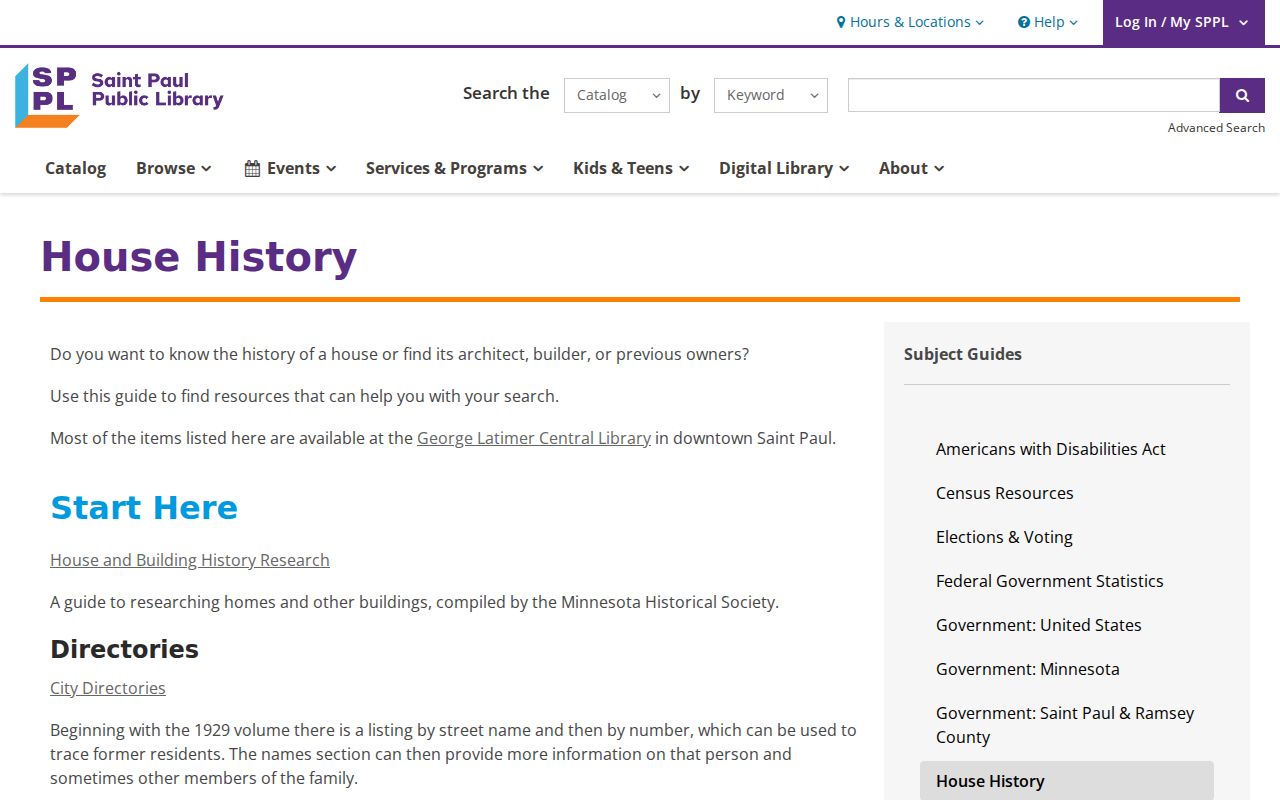
The image is a starting point for a former-household search, not a result for a particular address. Hennepin County Library's house-history guide adds Minneapolis lot surveys, plats, aerial images, vertical files, neighborhood newspapers, recorder documents, and newspaper access.
Minnesota Historical Society Sanborn lists cover selected city editions from 1867–1950 and 1950–1970. Their listings identify city, county, date, volume, edition, and microfilm reel. The MNHS Sanborn map collection and the Gale Family Library's microform readers can help compare building footprints and block geography. A fire-insurance map can date a change or suggest a structure's use, but it is not a current survey or proof of who owned or occupied the parcel.
Use the map index to confirm the city, edition, and sheet before comparing a building outline. A corner entrance, rear addition, outbuilding, or change in street alignment can help match a historic structure to today's parcel, especially where the lot was split. Sanborn coverage is selective, and a map records the built environment at its survey date, not a household list. Check a deed, directory, or census separately for people and dates.
Minnesota Address Permits, Surveys, Parcel Change
Permits and surveys help explain why an address looks different across two directory or deed years. They mark work on a parcel, not necessarily a transfer or a full list of residents. In St. Paul, public address reports cover code-compliance, permit, and vacant-building information; permits issued since January 1, 2000 are online, while Public Works permits start in 2006. Current and renewal-pending occupancy records and valid TISH and code reports have separate public views.
Use the St. Paul property-information and reports route for current address searches. If an older file is not online, contact the responsible city department and request inspection or copies under Minnesota's data-practices law. Hennepin's house-history files identify selected Minneapolis lot surveys and permit work from 1916–1965, tied to permit cards B122143–B394097; not every building has a survey. Plats, aerial photographs, survey records, and tax rolls can bridge a split lot or changed parcel number.
Saint Paul's PAULIE system launched September 17, 2025. The city says it has more than 20 years of information while historical conversion is still underway, so an older file's absence from a new portal needs follow-up. Ask the department that created the permit or inspection record for its public-search route, retention period, and chapter 13 copy process. An inspection request is free; if you need a copy, ask for the actual-cost estimate and the available paper or electronic format.
Minnesota Previous Residents: Directories, Census, Obituaries
A deed chain names transfer parties, while household sources can show people who used the Minnesota address. Directories may list one person, a spouse, or several adults depending on the year. Census schedules add family relationships and ages on a specific census date. The Minnesota city-directory collection guide covers the holdings; the steps here pair those records to one property over time.
- Search the address in the reverse or street-number section for each available directory year. Copy the spelling, street form, household marks, and any number exactly.
- Find that name again in the alphabetical section, then try initials or surname variants. A directory can omit people who were not listed under its head-of-household rule.
- Pair the year with the closest released federal census and, for Minnesota, the available state-census schedules. The census can add children, ages, birthplaces, and relationships that a street list lacks.
- Compare the household date with a deed, permit, newspaper item, or probate file. Keep each record's date and purpose beside the name rather than treating one clue as proof of continuous residence.
Federal census images are released through 1950 under the 72-year rule. Minnesota's indexed state-census collection spans 1849–1905, with schedules for 1857, 1865, 1875, 1885, 1895, and 1905. MNHS People Records Search includes state-census and historic death material. A death-index result can give a person's name, death date, county, and certificate number; use that number and year to locate a certificate record.
For a census comparison, record the year, county, city, ward, and enumeration-district number with the household entry. Census takers recorded people at a particular historical moment; they did not produce a continuous annual address list. If a directory gives a street address but the census image is indexed only by district or nearby place, use the district description and page sequence to inspect adjoining households. Names, ages, relationships, and birthplace details can help distinguish two people with the same name, but they still need to be matched to the right address and date.
Newspapers and probate can close an era. The Minnesota Digital Newspaper Hub includes historical papers from 1849 onward, subject to copyright limits on later issues; St. Paul's Pioneer Press has digitized coverage from 1861–1961. MNHS can search one person in up to two newspapers and up to seven daily or four weekly issues for $10, usually in three to four weeks and sometimes up to twelve. For a probate case, MCRO is the remote district-court search; courthouse MNPAC terminals show more public data, and local court administration handles paper files and certified copies. Uncertified copies are free and certified copies generally cost $14; requests can be made in person, by mail, or through eFiling using the court's copy-request routes. Older county probate books may have moved to the Minnesota State Archives, so include the county, date span, and record type when asking staff.
Lawful use. Previous-resident research in Minnesota is for house history, family history, and personal curiosity. Do not use a past address or name to follow, threaten, or harass a living person.