
Where Minnesota City Directory Runs Survive
Minnesota has no single statewide run. Begin with the city and year, then check its public library and the larger Minnesota Historical Society collections. St. Paul has a long mix of online pages, microform, and print. Minneapolis and nearby suburbs have digitized runs; other towns may rely on local shelves, a county historical society, or a Gale Family Library request.
| Collection | Years | Where Held | Access |
|---|---|---|---|
| St. Paul volumes | Online 1856–1922; fiche 1856–1859; film 1863–1935; print 1938–present | St. Paul Public Library, George Latimer Central Library | Online, microform, or print; print photocopying is not allowed |
| Minneapolis volumes | Hennepin digital 1859–1950; St. Paul Central Library print 1907–present | Hennepin County Library; Minneapolis Central Library; MNHS | Search digital scans; later print coverage varies by year |
| Edina, Hopkins, St. Louis Park | Edina 1941–1977; Hopkins 1942–1977; St. Louis Park 1933–1977 | Hennepin County Library digital collection | Search scanned pages by name or address |
| Hennepin suburban area | 1956–1988, plus city-specific runs | Hennepin County Library and print special collections | Reverse search by address where the volume supports it |
| St. Paul street and house-history series | Street-by-number list from 1929; Dual City Blue Book 1895–1923 | St. Paul Public Library House History resources | Use street index, then check the alphabetical name section |
| Minnesota telephone directories | Incomplete city and county holdings | MNHS Gale Family Library and county libraries | Ask for the specific city and year |
These dates name surviving collections; they do not promise that every year was published or retained. Ask the library to check its shelf or reel before a visit, especially when one year matters.
Digitized Minnesota City Directories by City
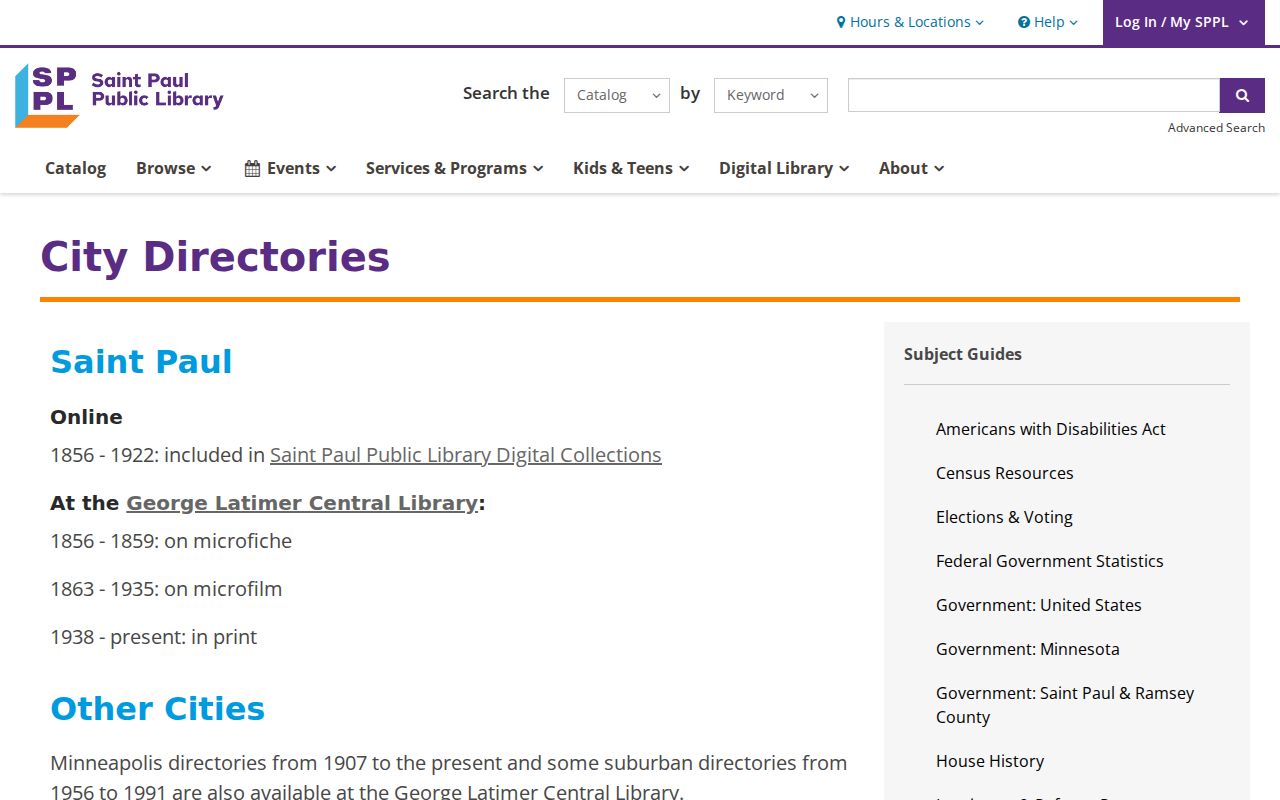
St. Paul Public Library scans let a reader move from a name entry to street-order pages. Depending on the year, use the online collection, a fiche reader, a film reel, or a print volume. Check the library's year notes before treating a missing hit as absence.
The St. Paul Public Library directory collection shows the series and its changes. This scan is a printed page, so read names and marks with the volume's own key.
Hennepin County Library adds Minneapolis, Edina, Hopkins, and St. Louis Park scans searchable by name or address. The Hennepin digital collection shows pages, not a modern person database. Interpret each typed entry against its page and year.
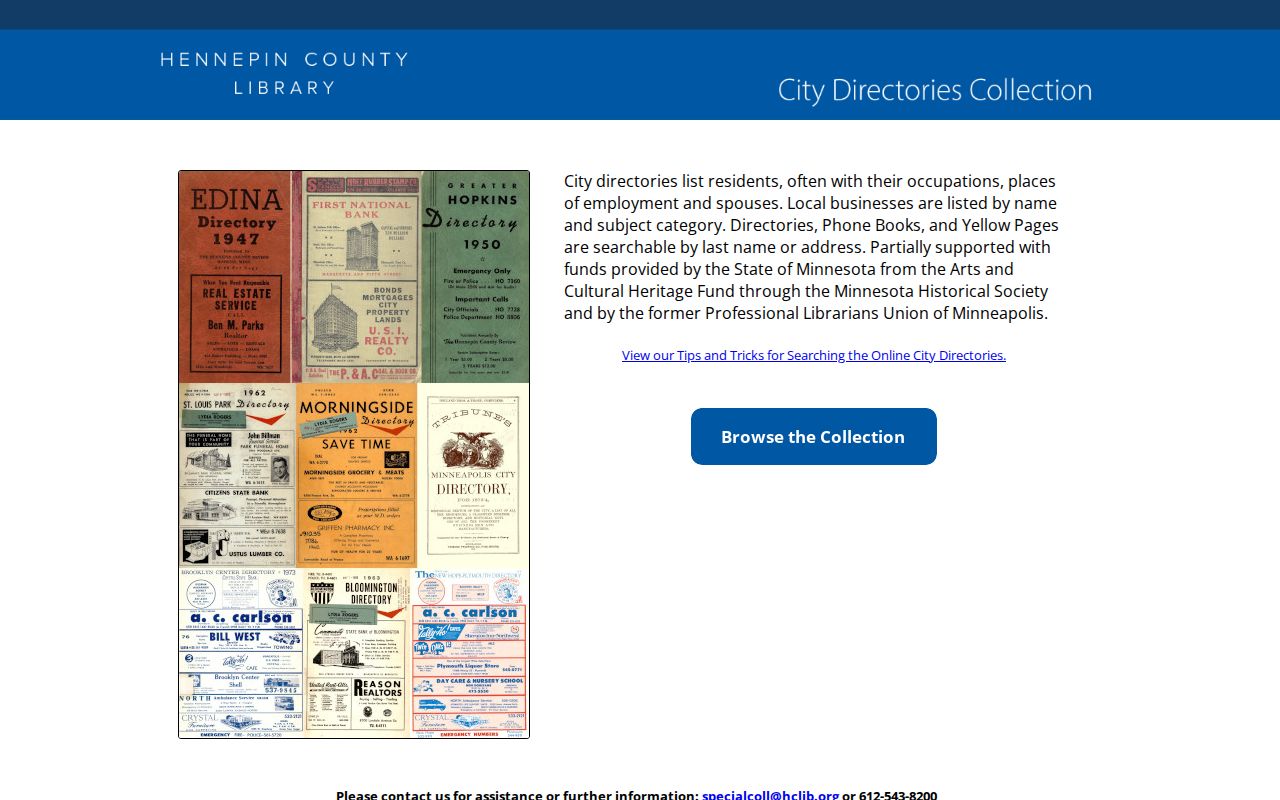
For those suburbs, the directory search covers the stated Hennepin years only. Check a different local library or MNHS when the right city or year falls outside that run.
How a Minnesota City Directory Entry Reads
A scan is an image of a printed page, not a clean database row. First note the year and the section heading. Then read the name, address, occupation or business type, and any spouse or household notation in that order. St. Paul volumes added more address detail over time, and the meaning of a mark can change between publishers or editions.
| Name | Alphabetical head-of-household entry; later runs may add a spouse, and St. Paul lists all adults after 1933. |
|---|---|
| Occupation or business | Trade, occupation, or business type, with wording that varies by year and publisher. |
| Address | Street name in early volumes; St. Paul house numbers appear from 1885, with street-by-number entries later. |
| Homeowner mark | A dotted-circle symbol in St. Paul from 1929 marks a homeowner; no mark is not a renter label. |
| Telephone mark | A bell appears in 1940; street-index telephone numbers arrive in 1961 and a separate telephone section in 1964. |
| Other sections | Officials, schools, churches, hotels, societies, businesses, advertisements, and subject categories may follow. |
- Criss-cross directory
- A street-order section that lets a researcher start with an address and look for the named person or business at that place.
- Householder index
- The alphabetical name section, usually organized around the person the publisher treated as head of the household.
- Abbreviation key
- The volume's own guide to shortened words and symbols; check it before reading a mark as a relationship or status.
Directory conventions can hide people. Minors are not normally named, and women may appear only when listed independently under the publisher's head-of-household rule. A household's absence from one volume does not prove that it moved.
Note: Copy the exact spelling, abbreviation, and address from the page before testing a normalized name in another index.
Trace a Minnesota Household Through City Directories
Directory entries show movement between census years; census pages can name children and give ages that a book omits. Pair the sources, and note each city, year, page, spelling, and address.
- Search street/address pages in each available year; record the name, number, occupation, adults, and symbols.
- Check the alphabetical section for a spouse, business, or alternate address.
- Try initials, surname variants, and nearby years if a scan is faint or a person disappears.
- Pair the result with federal and Minnesota state-census years to find household members and ages.
- Test a move or death with an obituary, cemetery register, probate file, deed, or dated notice.
Federal census images are released through 1950 under the 72-year rule. Minnesota state-census years are 1857, 1865, 1875, 1885, 1895, and 1905; MNHS indexes state censuses from 1849 through 1905. The sources differ because they record separate dates and define a household in different ways.
A change can also reflect a renamed street or new number. St. Paul's House History guide has former street names and maps; Hennepin pairs address searches with plats and lot surveys. For a present-day parcel chain, use the Minnesota by-street records.
Minnesota City Directory Changes in St. Paul
St. Paul's printed directories changed in ways that affect how far back a researcher can follow a numbered address. The early books grouped entries by ward; later ones added street indexes, house numbers, and household details. This indexing quirk means a familiar-looking line may carry a different kind of evidence depending on its year.
| Year | Change in the St. Paul volumes | How to use it |
|---|---|---|
| 1866 | Entries arranged by ward | Use ward context before assuming the list is citywide alphabetic. |
| 1879 | Street-name index adds “to” and “from” information | Trace the street section before searching by modern number. |
| 1885 | House numbers appear | Address matching becomes more precise. |
| 1929 | Dotted-circle homeowner mark, wives named after husbands, and pink-paper street index | Read the legend and street index together. |
| 1933 | All household adults are listed | More than one adult may appear at an address. |
| 1940 | A bell marks a telephone | The mark signals a phone, not a full number. |
| 1961–1964 | Phone numbers enter the street index; a separate phone section follows | Check both the street and telephone sections. |
These changes are strongest in St. Paul and should not be projected onto every Minnesota publisher. The page legend and index tell you what the volume means; a similar symbol in another city's book may stand for something else.
Gale Family Library Search and Request Options
The Gale Family Library at the Minnesota History Center holds local histories, newspapers, maps, biographies, oral histories, and archives. Visit by appointment Thursday through Saturday, 10 a.m. to 4 p.m., at 345 West Kellogg Boulevard in St. Paul. Call 651-259-3300 or email infodesk@mnhs.org before a trip.
The Gale Family Library collections page shows the wider sources that can explain a name or address.

MNHS staff can search one name or business in up to five directory or phone-book years: $10 for either search, $20 for both, plus a $5 processing fee. Delivery is usually three to four weeks, sometimes twelve; staff return the expected page if a name is absent.
Microform is in the Ronald M. Hubbs Room; other material is in the Weyerhaeuser Room. Check MNHS research services and the directory request page for details.
Ramsey County's St. Paul History Shelves
The Ramsey County Historical Society Research Center adds a local route for St. Paul and Ramsey County. Its noncirculating holdings include books, periodicals, directories, maps, photographs, personal papers, business and organization records, architectural materials, and school, church, and club files. The center is in Landmark Center at 75 West Fifth Street, open Monday through Thursday from 1 p.m. to 5 p.m.; appointments are strongly encouraged.
Before visiting, check the Ramsey County Historical Society Research Center for collection search and contact details, or call 651-204-1283. The image shows the research center's collection route, which can add a building, school, or community file beside a directory entry.
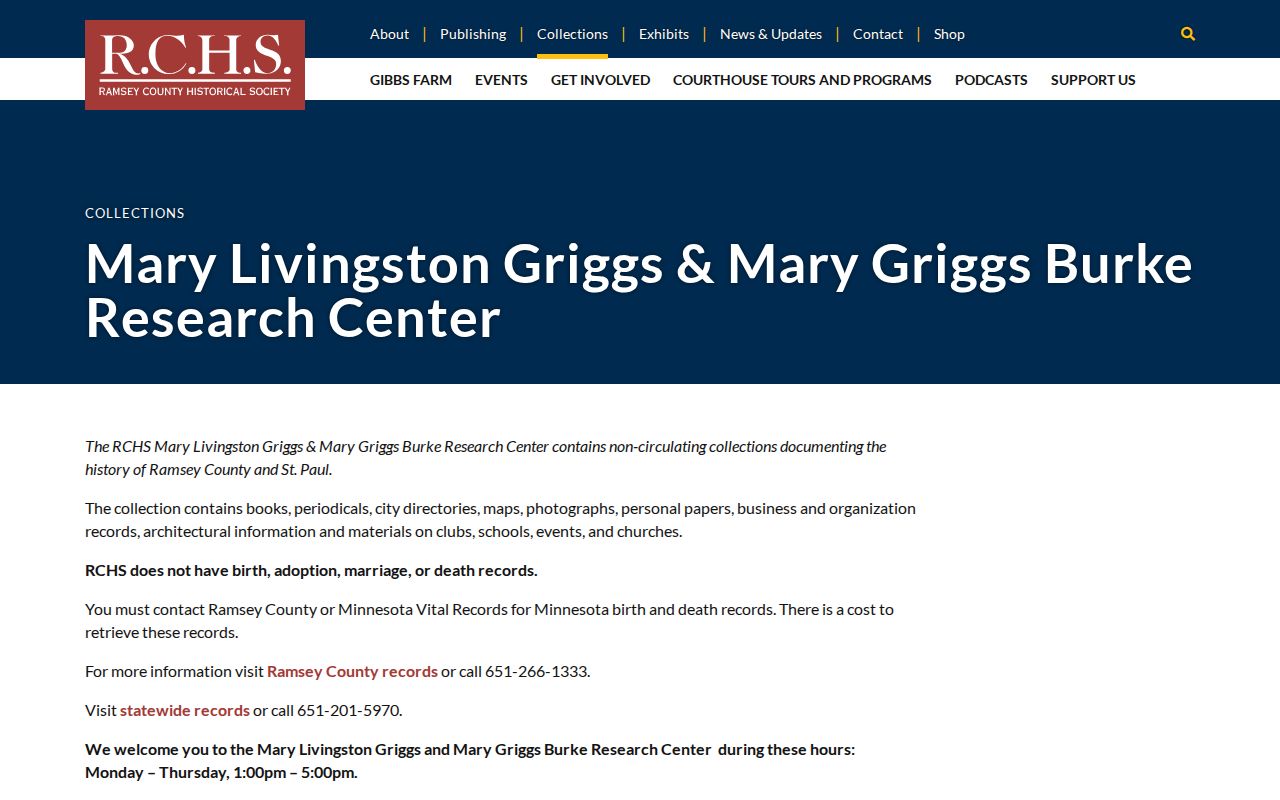
The center does not hold Minnesota birth or death certificates; it directs those requests to Ramsey County or MDH. That division matters when a history question turns into an official event record request.
Newspapers and Phone Books Form Separate Series
A telephone book is not simply a later volume. Minnesota's telephone holdings are incomplete by city and year, and names or addresses may be indexed differently. Ask Gale or a local library for the exact place and year before assuming the print run also marks the end of phone coverage.
The Minnesota Digital Newspaper Hub covers 1849 to the present; copyright limits put many later issues at Gale Family Library. No master index covers every Minnesota obituary, article, or advertisement. Search by paper and city, then test the person's name or address in its index. Yearbooks and church directories can add a school, congregation, or family link.
MNHS searches one person in up to two newspapers and seven daily or four weekly issues for $10, including scans and processing. Delivery is usually three to four weeks, sometimes twelve. Pair a notice with a death index or another record instead of treating it as a full residence history.
Note: A directory entry dates a printed listing, while a newspaper notice may refer to an earlier event or a different city.
The 1915 Market Hall Library Fire
In 1915, a fire at Market Hall destroyed the building and most of St. Paul Public Library's 158,000-book collection. The surviving series now spans online scans, fiche, film, and print, so check each format instead of expecting one continuous shelf.
The fire gives context for local research gaps, but does not show whether a certain volume was published or survived. Ask the library for the exact year and note its format.
When a Minnesota City Directory Year Is Missing
If a needed volume is not online, search the MNHS catalog by city, county, publisher, or date. Ask Gale about film, print, or a nearby-year search, then check the county library and historical society. Hennepin scans can bridge Minneapolis-area gaps; St. Paul's House History guide adds former street names, atlases, and handifiles.
For older households, pair directories with federal and Minnesota state censuses. A missing name may lead to the Minnesota People Records index, newspapers, church or cemetery registers, or probate. Treat each as a dated clue, not proof of continuous residence.
For a present-day person or court record, use the Minnesota resident lookup page; modern parcel questions belong in the current address-record chain.