
Finding Residents Across Minnesota
A useful Minnesota residents directory begins with the kind of link you need to confirm. A name may lead to a voter-status check, a court index, or a state historical index. An address points first to the parcel and the county that keeps its tax and title records. An older household may show up in a city directory or census even when no current record uses the same spelling.
These sources do not describe the same thing. An assessor names a taxpayer or owner, a voter lookup confirms a registration match, and a directory captures an entry for one city and year. Start with the strongest known detail, then compare a second source with a different custodian and date.
- Write down the full name or address, the likely city or county, and any known date. Keep the source's spelling before trying variants.
- For an address, use the county property search or parcel map to find a parcel ID and owner or taxpayer entry.
- For one person's own registration, use the state lookup with the name, birth date, and address it requires.
- Use court, vital, business, or historical indexes only for the question each one can answer, then check the record with its custodian.
- If a portal leaves a gap, ask the responsible office, courthouse, county registrar, library, or archives for its counter, mail, or research route.
Who Keeps Minnesota Resident Records
Minnesota divides resident-related records among state and county custodians. The state supports court, vital-record, election, archive, and license searches; the county containing a property or event remains central for deeds, parcel values, marriage issuance, local tax data, and many copies. A Minnesota residents directory is therefore a route to the right office, not a single master roll.
Three statewide starting points help sort the work. The county registrar directory identifies a nearby vital-record counter, while the Minnesota Historical Society connects researchers to collections and reference help. The Secretary of State's voter tools serve registration checks and restricted list requests through separate routes.
Minnesota Historical Society
Gale Family Library
345 W. Kellogg Blvd., Saint Paul
651-259-3300
Minnesota Vital Records
Statewide products through MDH and county registrars
Choose the county counter for the record or service needed.
Minnesota Elections
Voter-status search and list requests
List forms go to 332 Minnesota Street, Suite N201, Saint Paul.
Minnesota County Records Shape Resident Searches
A Minnesota address points to a county system, not a statewide deed-image archive. County recorders or registrars of titles hold local deeds, mortgages, liens, releases, plats, and title records. Assessors and treasurers keep parcel, value, tax, and sales details. Elections, court, and registrar duties may sit in other county offices, so a city name alone may not identify the right custodian.
The Minnesota Geospatial Information Office, or MnGeo, links to county parcel data and map viewers. Some counties offer owner-name and parcel searches; others rely on a map or a vendor interface. MnGeo warns that parcel lines are approximate, so a map helps find an office or parcel but does not replace a recorded legal description or survey. Use the county listed for the address before ordering a deed or making a records request.
A question about a street, parcel, or deed chain belongs in the Minnesota street directory workflow, where the county-by-county steps are set out.
Minnesota Resident Addresses Lead to Property Records
A county property card can connect a Minnesota address to an owner or taxpayer, parcel ID, assessed value, sales data, and sometimes a mailing address. The Minneapolis city search adds neighborhood, ward, precinct, lot, and classification tabs. These are parcel facts, not a list of everyone who lives at that location. A different mailing address may belong to a trust, relative, or service contact.
MnGeo's county parcel directory routes a search to the local map and property system. The county view below shows the statewide starting point; after choosing a county, use that county's own fields and access rules.
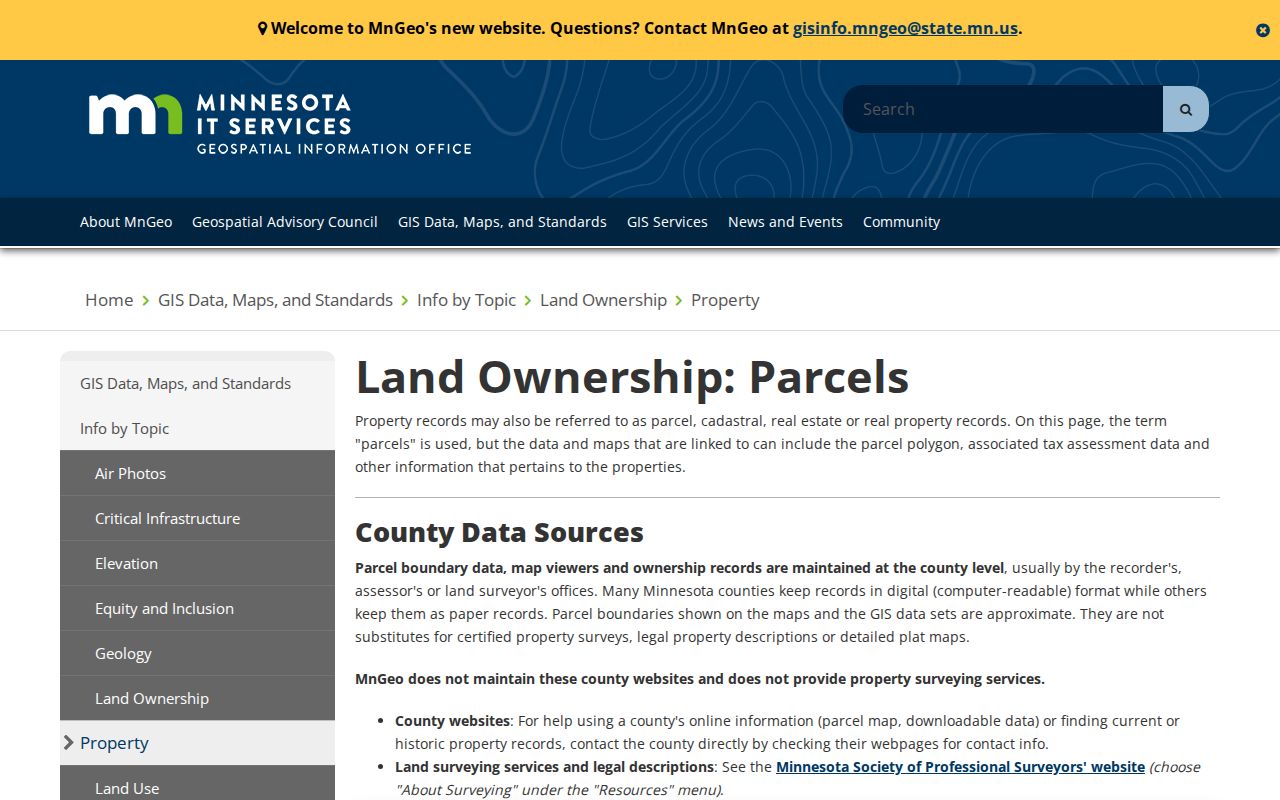
The statewide map list is a way into local parcel information. The county assessor or recorder remains the source for the official record and any copy request.
| Hennepin search mode | Type | Required | What it opens |
|---|---|---|---|
| Property address | Address search | One search mode | Parcel and tax information |
| Property ID number (PID) | Parcel identifier | One search mode | Property record for the PID |
| Addition name | Subdivision search | One search mode | Lots in the named addition |
| Property interactive map | Map search | One search mode | Parcel selection by location |
- Parcel ID
- A county's identifier for a tax parcel; it is not a street address or ZIP code.
- Situs address
- The location assigned to the property, which may differ from the tax mailing address.
- Index
- A guide to records and their filing details; the scanned document or certified copy may require another access step.
Today's Minnesota Resident Records
Current Minnesota resident searches work best when each source is read for its own purpose. A property card connects an owner or taxpayer to a parcel; the voter lookup checks a person against registration data; the court portal indexes cases. None is a complete resident roll. Use two sources with different custodians when a name match needs more context.
| Record route | What it can show | Keeper | How to reach it |
|---|---|---|---|
| County property card | Owner or taxpayer, parcel, value, and some sales details | County assessor or treasurer | County portal or counter; county links at MnGeo |
| Voter status | A match for the name, birth date, and address entered | Secretary of State Elections | MNVotes; full-list requests have separate eligibility rules |
| Deed and title index | Parties, filing date, instrument, and legal description | County recorder or registrar of titles | County index, kiosk, counter, mail, or copy form |
| Court case search | Case parties, filings, register of actions, and eligible public documents | Minnesota Judicial Branch | MCRO, courthouse terminal, or court administration |
| Historical people indexes | Selected births, deaths, censuses, and service records | Minnesota Historical Society | People Records Search and library/archive help |
Property, court, and history tools can all return a similar name while describing different people or dates. A search result is a lead to a source record, not proof by itself. Read the access notes beside each index and contact its custodian for the underlying copy when needed.
MNVotes Checks Minnesota Voter Status, Not a Resident Roster
The Minnesota registration lookup requires first name, last name, date of birth, and an address. The address step can start with a ZIP code or county, then narrows to the street. Name entry accepts letters A to Z, spaces, hyphens, and apostrophes; diacritics and other characters can cause a failed match even when the record is present.
MNVotes is free and updates nightly, but an election office may take up to 14 days to process an application. A registered Minnesota voter can request a public list for a permitted purpose under Minn. Stat. §201.091, using the Secretary of State's voter-list instructions. It is not an online browse tool: requests go by mail or in person, local reports cost $30 and statewide text lists cost $46, with five-business-day fulfillment stated on the form. Protected voter fields and Safe at Home addresses remain restricted.
Minnesota Court Records Have Four Search Doors
Minnesota Court Records Online (MCRO) separates Case Search, Document Search, Hearing Search, and Judgment Search. A name search can use an exact spelling, a trailing wildcard after two characters, or the Sounds Like option. The search can narrow by birth date, filing date, case category, status, and county, but a person’s street address is not shown in the remote result.
These are the inspected case-search fields. Leave optional filters open if the county or date is not known, then review the Register of Actions rather than treating a category label as the outcome.
| Field label | Type | Required | Options and format |
|---|---|---|---|
| Name type | Radio/button | Yes for name route | Person or Business; exact, trailing wildcard after two characters, or Sounds Like |
| Last, first, middle name | Text | Route-dependent | Try middle-name and no-middle-name forms |
| Date of Birth | Date | No | Exact date or range, MM/DD/YYYY |
| Date Filed | Date | No | Exact date or range, MM/DD/YYYY |
| Case Category and Status | Checkbox/select | No | Civil, Criminal, Family, Probate or Mental Health; displayed status options |
| Court Locations | Radio/checkbox | No | Statewide or selected county locations; all 87 counties are available |
| Case number, citation, or attorney | Search-tab text | Route-dependent | Use the matching search tab for a known number or attorney |
A case detail can show the case number, court location, parties, status, filing date, hearings, judgments, event list, and public documents when remote access permits. Some event rows have no attached file, and confidential case types or documents may not appear online.
- Case identity: number, category, county, filing date, and status.
- Party details: name, role, and available attorney information.
- Event record: Register of Actions entries, dates, hearings, and document-index numbers.
- Judgment and document layer: docketed date, status, satisfaction details, and downloadable public PDFs when eligible.
Minnesota Court Records Need a Courthouse Backup
Remote MCRO access is useful, but it is not the only public route. The courthouse public access terminal, called MNPAC, can show material that does not appear in the remote view, including some public domestic-abuse and harassment cases, CHIPS and civil-commitment documents, and party address fields. Court administration holds paper files and can explain how to request certified copies.
| Route | What it provides | When to use it |
|---|---|---|
| MCRO | Remote case, document, hearing, and judgment searches; free eligible downloads | Start with a name, case number, or county |
| Courthouse MNPAC terminal | Broader public electronic access than remote MCRO | When a remote result is missing or restricted |
| Local court administration | Paper and archived files, certified copies, and local request instructions | When an official copy or older file is needed |
Uncertified copies are free; certified copies generally cost $14 per document, while exemplified copies have a separate fee. Mail, in-person, and eFiling routes are available under court procedures. A probate file may help trace an heir, but it does not establish where that person lives today.
Birth, Death, Marriage, and Divorce Need Different Routes
Minnesota vital records are split by event and by the copy being requested. MDH and county registrars share a statewide system for many birth and death products, and a customer can use any county for many services. Birth data have special privacy rules, including a 100-year period before restricted data become public. A certified birth or death copy requires the prescribed attestation, identification, and an eligible relationship or other qualifying interest.
Death records are public for noncertified informational copies, while certified copies still require eligibility. The Minnesota Official Marriage System indexes many marriage records, but the certificate comes from the county that issued the license. Divorce decrees are held by the district court that granted the divorce, not by MDH. The county registrar directory and MDH forms show the correct mail, fax, counter, payment, and copy route for the product.
Minnesota Residents Use Genealogy Indexes With Different Years
The Minnesota Historical Society's free People Records Search brings several state indexes together, but each series has its own years. Birth entries cover 1900-1934, death entries 1904-2001, and state-census records 1849-1905. The search also reaches Veterans Graves Registrations from 1857-1975 and World War I Gold Star Rolls from 1915-1921.
A death hit may provide a certificate number and county; for many years it also has birth details and a mother's maiden name. State-census records can add age, birthplace, census location, and parents' birthplaces. Images and copies use different access paths, so take the index year and certificate number to the Gale Family Library or ask MNHS staff what can be viewed remotely. An index gap is not proof that a record never existed.
Minnesota Property Records and eCRV
Minnesota's electronic Certificate of Real Estate Value search adds a sale record to a parcel trail. The public eCRV system holds accepted and completed certificates from October 2014, when electronic filing became statewide for covered transfers. A certificate is required for a Minnesota real-property transfer for consideration over $3,000.
The current Minnesota Revenue eCRV public search offers custom, eCRV ID, and parcel ID routes. Its data describe sale terms and parcel identifiers; they do not replace a recorded deed, certificate of title, or complete chain of title. Revenue moved production applications to new URLs in July 2026, so older bookmarks may no longer lead to the live search.
Minnesota Resident Search for Family Trails
A family-history search takes a different route from a current-address question. An heir may appear in probate, a deed, an obituary, or a death index; a former classmate may be named in yearbooks, city directories, and school archives. A birth-parent search should follow Minnesota's official adoption and original-birth-record procedures, including the Minnesota Fathers' Adoption Registry when it applies.
These records answer different questions. A newspaper notice can connect relatives or mark a move, while a probate file names an estate representative or heirs. A yearbook fixes a person to a school and year, not a current household. Use the dated source that fits the family question, then ask the custodian or repository about access to the original item.
Minnesota's Historical Directories Trace Earlier Residents
City directories turn a name and a city into a dated household clue. St. Paul volumes are online for 1856-1922, with microfilm through 1935 and print volumes from 1938 onward. Hennepin County's digitized runs include Minneapolis for 1859-1950 and several suburbs for selected years. A reverse or criss-cross section starts with a street or house number and points back to an occupant name.
For a statewide search, check the MNHS catalog and Gale Family Library as well as the city or county library that serves the place. Older print, microfilm, telephone books, and newspaper indexes may need an in-person visit or a staff search. The longer collection-by-collection history is on the Minnesota city directory page.
Safe at Home Limits Minnesota Address Search
Minnesota's Safe at Home program gives eligible participants a designated post-office box address and forwards first-class mail. Under chapter 5B, participant information other than the name and assigned address is private, and a real address is released only through limited court-order or emergency and law-enforcement procedures. A public parcel or voter search may therefore fail to show a protected location.
Do not try to infer a protected address from a relative, parcel, or old directory entry. When a record seems incomplete, use the program's official contact route or ask the record custodian what information may lawfully be released.
Lawful use. Public records support personal research and civic understanding. Do not use a search result to follow, threaten, or harass someone; a custodian can explain the proper route for a record concern.
Chapter 13 Requests Fill Minnesota Record Gaps
The Minnesota Government Data Practices Act, Minn. Stat. chapter 13, lets any person inspect public government data at reasonable times and places. Inspection is free. Copy charges may reflect actual costs and applicable rules, and an office that denies access must identify the legal basis. Agencies should respond in a reasonable time based on the work involved; chapter 13 sets no one numeric deadline for every request.
Send the request to the responsible authority for the agency or county that holds the record. Name the fields, date range, and format you seek, and ask for an itemized estimate before copies are made. The law does not require an office to create a new record or answer a question that is not a request for existing data. For historical material, a county counter, MNHS catalog, library reference desk, mail request, or archives staff search may be the better next step.